








Security Implications of IoT Devices in Critical Infrastructure: Risks, Vectors, and Mitigations
The integration of IoT devices into critical infrastructure has fundamentally altered the threat landscape for operational technology environments. What were once air-gapped, purpose-built control systems now share network adjacency with internet-connected sensors, actuators, and embedded systems — creating a convergence problem that neither IT security nor OT engineering disciplines were originally designed to solve.
Why Critical Infrastructure Is a High-Value Target
Critical infrastructure sectors — power grids, water treatment facilities, transportation networks, and healthcare systems — represent high-value targets precisely because disruption carries immediate physical consequences. Unlike a data breach affecting enterprise IT, a successful attack on a water treatment SCADA system or an electrical distribution network can cascade into public safety emergencies within hours.
Threat actors ranging from nation-state groups to ransomware operators have recognized this asymmetry. The cost to mount an attack is often orders of magnitude lower than the societal cost of the disruption it causes. This leverage dynamic makes critical infrastructure uniquely attractive, and the growing density of IoT devices in these environments has expanded the available entry points considerably.
The stakes are compounded by the operational constraints of these sectors. Downtime windows for patching are measured in months, not days. Safety-critical processes cannot tolerate the latency introduced by aggressive security controls. These constraints are not excuses — they are engineering realities that any credible security framework must account for.
How IoT Expands the Attack Surface in OT Environments
Connecting IoT devices to legacy OT/ICS systems introduces entry points that traditional perimeter defenses were never designed to handle. Classical OT security assumed physical isolation; modern deployments assume connectivity, and the gap between those assumptions is where most risk accumulates.
Legacy SCADA systems and programmable logic controllers (PLCs) were engineered for reliability and determinism, not confidentiality or integrity in the cryptographic sense. When IoT sensors and remote monitoring devices are grafted onto these systems — often to enable predictive maintenance or regulatory reporting — they create bidirectional data paths that bypass the implicit security model of the original architecture.
The IT/OT convergence problem is not merely topological. It is also temporal: IoT devices operate on update cycles measured in years, while the threat landscape evolves in weeks. A sensor deployed in a substation in 2019 may be running firmware with known CVEs that will never be patched because the vendor no longer supports the hardware, or because the patch process itself poses an unacceptable operational risk.
Common Vulnerability Classes in Industrial IoT Devices
Industrial IoT devices share a consistent set of vulnerability classes that appear repeatedly across CVE disclosures and security audits. Understanding these patterns is more useful than cataloging individual CVEs, because the root causes tend to be architectural rather than incidental.
- Firmware security weaknesses: Many embedded systems ship with unsigned firmware, no secure boot implementation, and no mechanism to verify update integrity. An attacker with physical or network access can flash malicious firmware that persists across reboots and survives factory resets.
- Default and hardcoded credentials: A significant proportion of deployed industrial IoT devices retain manufacturer default credentials or contain hardcoded authentication tokens embedded in firmware. These are trivially discoverable through public documentation or binary analysis.
- Unencrypted communications: Protocols common in OT environments — Modbus, DNP3, older variants of OPC — were designed without transport-layer security. IoT devices that speak these protocols natively, or that bridge them to IP networks, expose control plane traffic to interception and replay attacks.
- Absent patch management: Unlike enterprise endpoints, most industrial IoT devices have no automated update mechanism. Patch deployment requires manual intervention, often during scheduled maintenance windows that may occur annually or less frequently.
- Insufficient network isolation: Devices are frequently deployed with broader network access than their function requires, violating the principle of least privilege at the network layer.
The combination of these weaknesses is particularly dangerous. A device with default credentials, unencrypted communications, and no patch path is not merely vulnerable — it is a persistent, low-friction entry point that degrades the security posture of every system it touches.
Notable Attack Patterns and Incident Archetypes
Several recurring attack patterns characterize how adversaries exploit IoT weaknesses in critical infrastructure, even without attributing specific named incidents.
Supply chain compromise targets the firmware or software components of IoT devices before deployment. By compromising a device at the manufacturing or distribution stage, an attacker can establish persistence in environments that are otherwise well-defended. The difficulty of detecting implants in embedded firmware — particularly in devices with no integrity verification — makes this vector especially concerning for high-security deployments.
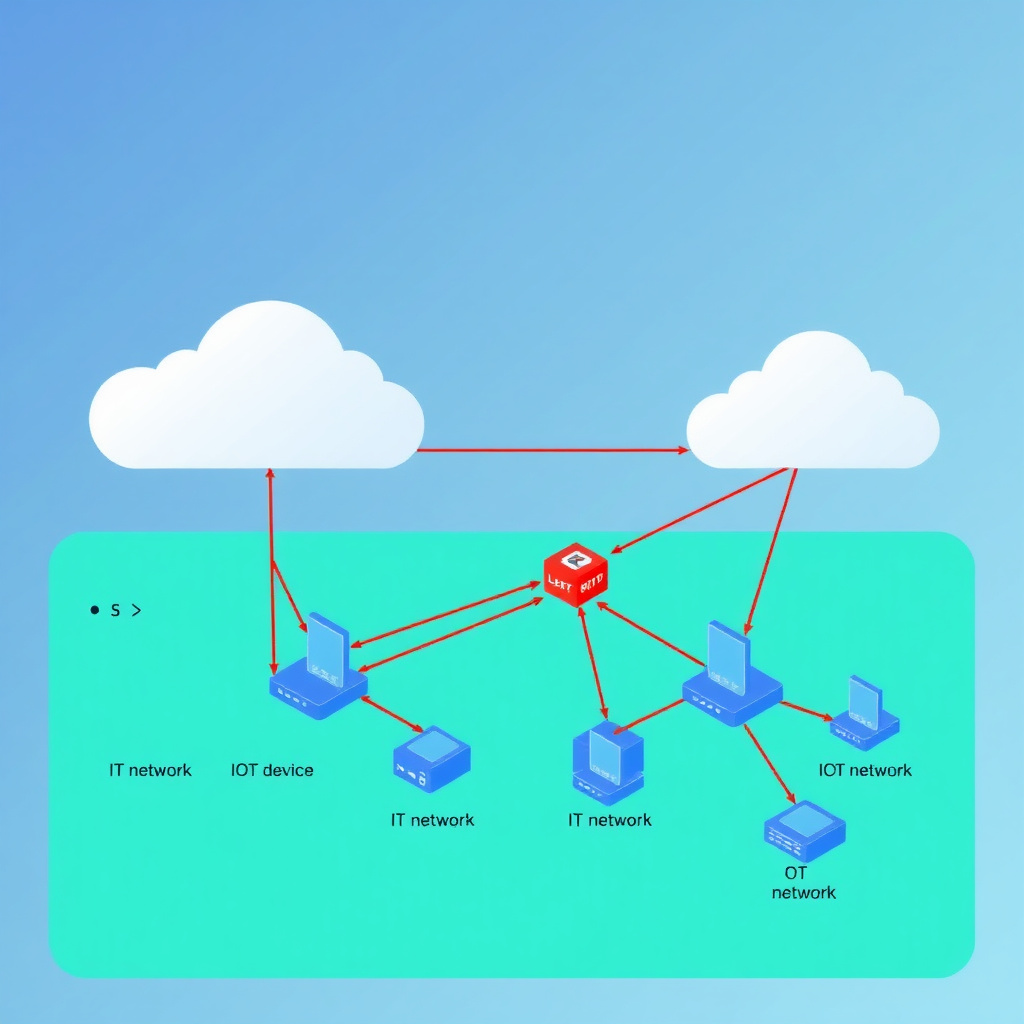
Lateral movement from IT to OT is the most operationally significant pattern. An attacker who gains a foothold in the enterprise IT network — through phishing, a vulnerable VPN endpoint, or a compromised IoT device on the corporate network — can pivot toward OT systems if network segmentation is inadequate. The IoT device itself often serves as the bridge, sitting in a network zone that has visibility into both domains.
Denial-of-service against control systems exploits the real-time constraints of OT environments. Unlike enterprise applications that can tolerate brief unavailability, SCADA systems and industrial controllers may fail to unsafe states when communication is disrupted. Flooding a control network with malformed packets — or simply saturating bandwidth — can trigger protective shutdowns with physical consequences.
Regulatory and Standards Landscape
Several frameworks provide structured guidance for IoT security in critical infrastructure, though none fully resolves the tension between OT operational constraints and modern security requirements.
The NIST Cybersecurity Framework (CSF) offers a sector-agnostic structure organized around Identify, Protect, Detect, Respond, and Recover functions. Its value in OT contexts lies in its flexibility — it does not prescribe specific controls, which allows organizations to adapt it to environments where standard IT security controls are impractical. NIST SP 800-82 provides more specific guidance for industrial control system security.
IEC 62443 is the most technically rigorous standard specifically addressing industrial automation and control system security. It defines security levels, zones, and conduits in a way that maps directly to OT network architecture. For IoT deployments in critical infrastructure, IEC 62443-4-2 (component-level security requirements) is particularly relevant, as it specifies what security properties individual devices must support.
NERC CIP applies specifically to the bulk electric system in North America and mandates specific controls for electronic security perimeters, physical security, and incident response. Its prescriptive nature makes it more directly enforceable than framework-based approaches, though it has been criticized for lagging behind the pace of IoT adoption in grid environments.
Mitigation Strategies and Architectural Recommendations
Effective mitigation in OT environments requires adapting security controls to operational constraints rather than importing enterprise IT practices wholesale. The following approaches have demonstrated practical value.
Network segmentation remains the highest-leverage control available. Placing IoT devices in dedicated network zones with strictly controlled conduits to OT systems limits the blast radius of a compromise. Unidirectional security gateways (data diodes) are appropriate for monitoring traffic that flows from OT to IT, preventing any return path that could be exploited for command injection.
Zero-trust architecture principles — verify explicitly, use least-privilege access, assume breach — translate into OT contexts as device identity verification, role-based access to control functions, and continuous monitoring of device behavior against established baselines. The challenge is implementing these principles on resource-constrained embedded systems that may lack the compute capacity for certificate-based authentication or behavioral telemetry.
Firmware signing and secure boot should be treated as baseline requirements for any new IoT procurement in critical infrastructure. Devices that cannot demonstrate cryptographic integrity of their firmware should be treated as untrustworthy regardless of other security properties. This is a procurement and vendor management problem as much as a technical one.
Comprehensive asset inventory is a prerequisite for everything else. You cannot segment, monitor, or patch devices you do not know exist. Passive network discovery tools designed for OT environments — which observe traffic without injecting packets that could disrupt control processes — are the appropriate mechanism for maintaining inventory in live systems.
Open Research Challenges and Conference-Relevant Directions
Several problems in this space remain genuinely open, making them productive areas for computational security research.
Real-time anomaly detection on resource-constrained devices is an unsolved problem at scale. Behavioral detection approaches that work well on enterprise endpoints assume compute resources, persistent storage, and network bandwidth that many industrial IoT devices simply do not have. Lightweight intrusion detection models — particularly those that can run inference locally on microcontroller-class hardware — represent an active research frontier.
The secure-by-design mandate emerging from regulatory bodies in the EU and US raises a harder question: what does security-by-design actually require for a device that will be deployed for 15-20 years in an environment where the threat model will change substantially? Cryptographic agility, remote attestation, and post-quantum readiness in embedded systems are areas where the research community has more to contribute than current standards reflect.
Formal verification of firmware for safety-critical IoT devices is another underexplored direction. The gap between what formal methods can prove about software behavior and what practitioners can realistically apply during device development remains wide. Bridging that gap — particularly for the subset of IoT devices that directly actuate physical processes — has both theoretical interest and immediate practical value.
Finally, the economics of vulnerability disclosure in OT contexts deserve more rigorous analysis. CVE processes designed for enterprise software do not map cleanly onto embedded systems with no patch mechanism and decade-long deployment lifetimes. Coordinated disclosure frameworks that account for the operational realities of critical infrastructure remain an open policy and technical challenge.
Frequently Asked Questions
What makes IoT devices in critical infrastructure harder to secure than enterprise IT devices?
Industrial IoT devices typically have constrained compute resources, long deployment lifetimes, infrequent maintenance windows, and operate in environments where availability takes precedence over security. Unlike enterprise endpoints, they often cannot run standard security agents, receive automated patches, or tolerate the latency introduced by inline security controls. The operational context makes standard IT security practices difficult or impossible to apply directly.
How does the convergence of IT and OT networks increase cybersecurity risk?
IT/OT convergence creates network paths between systems with fundamentally different security assumptions. OT systems were designed for isolation and determinism; IT systems assume connectivity and accept some availability trade-offs for security gains. When IoT devices bridge these domains, attackers can use IT-side footholds to reach OT systems that were never designed to defend against network-based attacks.
What is the role of firmware security in protecting industrial IoT deployments?
Firmware is the foundational software layer of any embedded device. Without secure boot and cryptographic firmware signing, an attacker with access to the device — physical or network — can install persistent malicious code that survives reboots and is invisible to network-level monitoring. Firmware integrity verification is a prerequisite for trusting any other security property of an IoT device.
Which standards or frameworks apply specifically to IoT security in critical infrastructure?
IEC 62443 is the most directly applicable standard, covering security requirements at the system, zone, and component levels for industrial automation environments. NIST SP 800-82 addresses ICS security with US government context. NERC CIP applies specifically to the North American bulk electric system. The NIST Cybersecurity Framework provides a sector-agnostic overlay that can be applied across all critical infrastructure sectors.
What are the most effective network-level controls for limiting IoT-related exposure in OT environments?
Network segmentation with strictly defined conduits between zones is the highest-impact control. Unidirectional gateways prevent return-path exploitation for monitoring traffic. Passive asset discovery maintains inventory without disrupting control processes. Protocol-aware firewalls that understand OT protocols (Modbus, DNP3, IEC 61850) can enforce command whitelisting at the network layer, blocking unauthorized control operations even if a device is compromised.