Incident Response: Strategies for Containment, Eradication, and Recovery
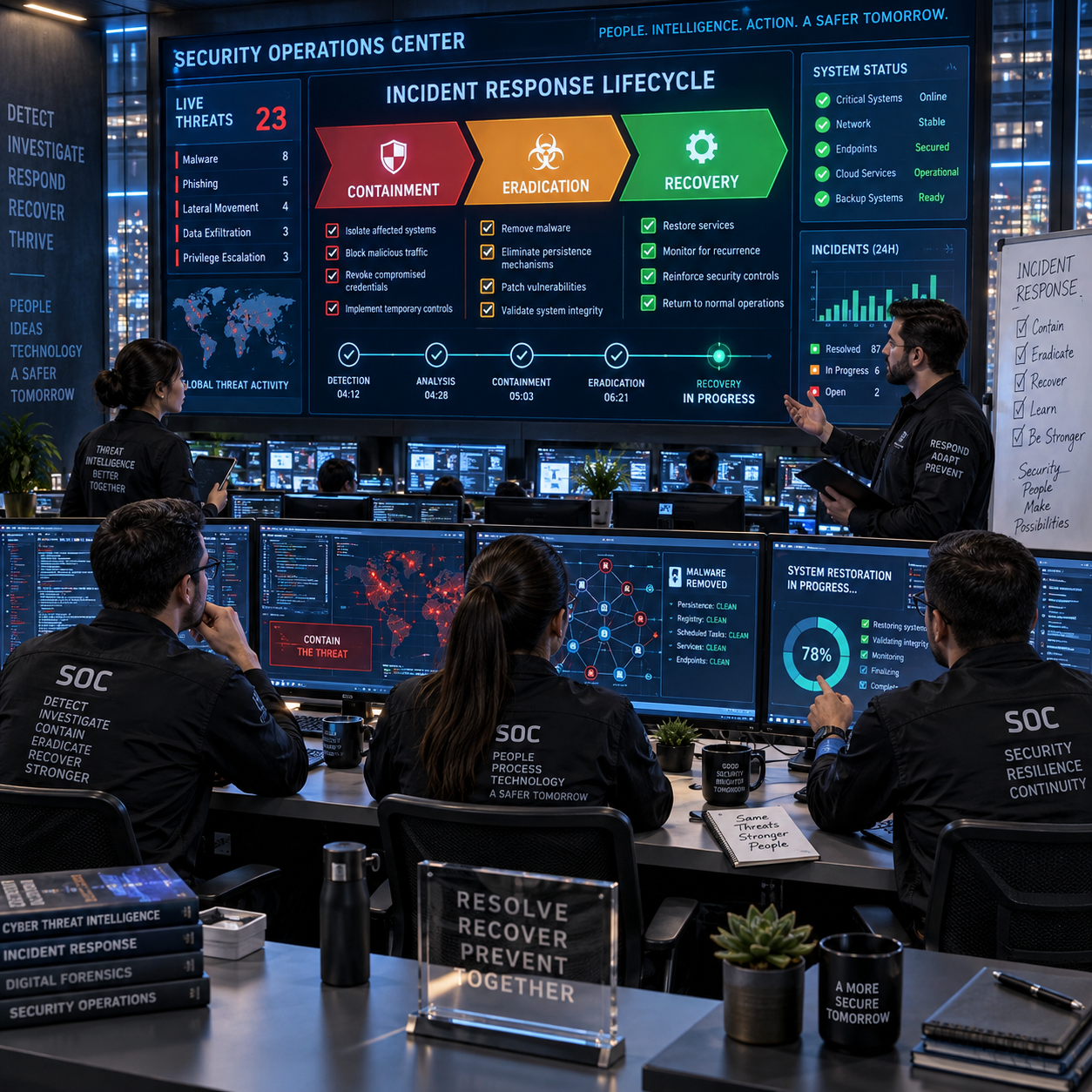
Effective incident response gives an organization a controlled way to detect, contain, eradicate, and recover from cybersecurity incidents. The strongest programs combine technical action with business judgment, evidence preservation, clear communications, and lessons that improve the next response.
What Is Incident Response?
Incident response is the organized process of preparing for, detecting, analyzing, containing, eradicating, and recovering from a security incident. It connects information security operations with business continuity, leadership, legal counsel, communications, and affected business teams.
An incident response process usually follows a lifecycle:
- Preparation: Build an incident response plan, assign responsibilities, train the incident response team (IRT), and test key procedures.
- Detection and analysis: Validate alerts, establish what happened, assess severity, and define the scope.
- Containment: Limit the attacker’s access and prevent further damage.
- Eradication: Remove malicious artifacts, close the attack path, and eliminate persistence.
- Recovery: Restore trusted services, validate their operation, and monitor for renewed activity.
- Post-incident improvement: Document findings and update controls, playbooks, and training.
This lifecycle is a guide rather than a rigid sequence. A ransomware incident may require immediate isolation before the investigation is complete, while a suspected insider threat may demand careful evidence preservation before access is revoked. The right response balances urgency, impact, safety, and the need to understand the event.
The NIST Cybersecurity Framework and NIST incident response guidance provide useful reference points, but each organization should adapt its process to its technology, risk profile, regulatory obligations, and operating model.
Preparation, Detection, and Initial Triage
Preparation, detection, and initial triage determine whether an organization can respond quickly without creating confusion. A useful plan identifies who makes decisions, which systems matter most, and how responders will communicate when normal channels may be unavailable.
An incident response plan should include contact details, escalation thresholds, authority to isolate systems, evidence-handling instructions, critical asset priorities, vendor contacts, backup procedures, and communication templates. The IRT may include security operations, incident handlers, digital forensics specialists, IT administrators, cloud engineers, legal counsel, privacy staff, communications professionals, and business owners.
Detection can begin with security information and event management alerts, endpoint telemetry, identity-provider warnings, threat intelligence, employee reports, vulnerability findings, or third-party notifications. Triage should separate genuine incidents from benign activity and answer four early questions:
- What is known, and what remains uncertain?
- Which accounts, devices, applications, and data may be affected?
- Is the threat still active?
- What action reduces harm without destroying useful evidence?
Severity assessment should consider data sensitivity, operational disruption, number of affected users, attacker privileges, safety implications, and the likelihood of propagation. Set a time-bound triage window, record assumptions, and escalate when evidence suggests active compromise, privileged-account abuse, widespread malware, or material business impact.
Containment Strategies
Containment limits an incident’s spread and reduces immediate harm while the IRT investigates. The best containment action depends on the incident type, attacker access, system criticality, and the cost of interrupting business operations.
Short-term containment is fast and tactical. Examples include isolating an endpoint from the network, disabling a compromised account, blocking malicious domains, revoking active sessions, restricting remote access, or removing an exposed cloud resource from public access. These actions can stop an active attack, but responders should record the time, approver, affected asset, and expected side effects.
Long-term containment creates a safer operating state while eradication proceeds. Teams may segment networks, move workloads behind additional controls, restrict administrative pathways, enforce phishing-resistant multifactor authentication, rotate credentials, or place sensitive services under heightened monitoring.
Containment decisions should use a simple impact filter:
- Stop propagation: Can the action prevent the threat from reaching more systems?
- Protect essential services: Will isolation interrupt healthcare, manufacturing, customer, or safety-critical operations?
- Preserve evidence: Could the action alter volatile data, logs, or attacker tooling?
- Reduce attacker privilege: Can access tokens, credentials, or administrative routes be revoked?
For ransomware, isolating affected hosts and protecting backup infrastructure may take priority. For business email compromise, session revocation, mailbox-rule review, and payment-process controls may matter more than broad network isolation. Choosing speed for containment can mean losing some volatile evidence, so the IRT should involve forensic specialists before destructive actions when circumstances allow.

Eradication and Root-Cause Analysis
Eradication removes the attacker’s tools, persistence, access, and original vulnerability. It follows containment and requires enough root-cause analysis to prevent the same entry method from succeeding again.
Responders may remove malware, delete unauthorized scheduled tasks, clean web shells, rebuild compromised hosts, patch exploited software, correct cloud misconfigurations, and reset affected credentials. Credential remediation should include privileged accounts, service accounts, API keys, tokens, certificates, and secrets stored in automation systems. Resetting one user password rarely closes an incident if an attacker retained a cloud token or administrator session.
Confirming that access is gone
Eradication is incomplete until the team tests its assumptions. Review authentication logs, endpoint detections, firewall activity, DNS requests, cloud audit trails, persistence locations, and unusual privilege changes. Threat intelligence can help identify known infrastructure, malware indicators, tactics, techniques, and procedures associated with the intrusion, but indicators alone should not replace behavioral investigation.
Root-cause analysis should document:
- The initial access method, such as phishing, exposed credentials, exploitation, or a vulnerable service.
- The path from initial access to privilege escalation and lateral movement.
- The data or systems accessed, changed, encrypted, or exfiltrated.
- Controls that failed, were missing, or were bypassed.
- Technical and procedural changes needed to prevent recurrence.
Rebuilding every system may be appropriate for a deeply compromised environment, but it can be costly and disruptive. Selective remediation is reasonable when evidence is strong and the organization can verify system integrity. When confidence is low, a clean rebuild usually carries less residual risk than relying on a difficult-to-prove cleanup.
Recovery and Safe Return to Operations
Recovery restores trusted systems and business services in a controlled order, with validation and heightened monitoring. The recovery sequence should follow business impact rather than technical convenience.
Start with a prioritized list of services, dependencies, recovery time objectives, recovery point objectives, data owners, and restoration authorities. Critical identity, network, backup, communications, and customer-facing services may need different treatment depending on the incident. Validate backups before restoring them; an untested or compromised backup can reproduce the problem.
A practical recovery sequence includes:
- Confirm eradication criteria and approve the recovery decision.
- Restore systems from known-good images or backups.
- Patch, harden, and reconfigure systems before reconnecting them.
- Test authentication, data integrity, application dependencies, and security controls.
- Reconnect services in stages, beginning with the highest business priority.
- Apply enhanced logging, threat hunting, and alert thresholds during the monitoring period.
Business continuity and disaster recovery plans should align with incident response, but they serve different purposes. Business continuity keeps essential functions operating; disaster recovery restores technology and data. During a cyber incident, both plans must account for attacker persistence, uncertain data integrity, legal review, and the possibility that standard recovery procedures are unsafe.
Return services to normal only when the IRT and business owners agree that access is controlled, critical vulnerabilities are addressed, monitoring is active, and residual risk is accepted by the proper authority. Recovery is a business decision supported by technical evidence.
Communication, Coordination, and Evidence Preservation
Communication and evidence preservation keep an incident coordinated, defensible, and understandable to decision-makers. The IRT should establish a communication lead, an approved channel, an incident timeline, and rules for sharing sensitive details.
Internal updates should tell leaders what happened, what is affected, what the team is doing, what decisions are required, and when the next update will arrive. Technical responders need precise indicators and actions; executives need business impact, options, constraints, and risk. Employees may need practical instructions such as changing credentials, avoiding a service, or reporting suspicious messages.
Legal, privacy, regulatory, law-enforcement, cyber-insurance, customers, suppliers, and media contacts may require separate coordination. Notification duties vary by jurisdiction, sector, contract, and the type of data involved, so legal counsel should guide obligations rather than relying on informal assumptions.
Digital forensics and evidence preservation begin with disciplined documentation. Record timestamps with the relevant time zone, preserve original logs where possible, calculate file hashes, restrict evidence access, and maintain a chain-of-custody record. Capture volatile data when justified, including memory, active connections, processes, and logged-in sessions. Avoid opening or modifying suspected files unnecessarily.
Every major action should have an owner, timestamp, rationale, result, and linked evidence. A clean incident record helps investigators reconstruct events and allows leadership to distinguish confirmed facts from working theories.
Improving Incident Readiness
Incident readiness improves through repeated practice, measurable performance, and honest post-incident review. Organizations should convert response experience into updated playbooks, stronger controls, and decisions that can be made faster next time.
Playbooks should cover common scenarios such as ransomware, business email compromise, lost devices, cloud-account takeover, data exposure, insider threats, and denial-of-service attacks. Each playbook needs entry criteria, first actions, escalation paths, evidence requirements, containment options, recovery dependencies, and communication responsibilities.
Tabletop exercises that produce useful results
Tabletop exercises improve incident readiness by testing decisions without causing production disruption. Give participants a realistic scenario, introduce new facts in timed injects, and require them to approve actions such as isolating a critical server, notifying customers, or restoring from backup.
Measure more than attendance. Useful metrics include time to detect, time to triage, time to contain, time to revoke compromised access, time to restore priority services, percentage of critical assets covered by logging, and the number of overdue corrective actions. Metrics should expose bottlenecks rather than reward teams for closing tickets quickly.
A post-incident review should be blameless but specific. Identify which signals were available, where decisions stalled, which dependencies were misunderstood, and which controls reduced impact. Assign each improvement an owner and due date, then verify completion. Conference sessions, practitioner case studies, and peer exercises can add perspective, but readiness is built when those insights become tested procedures inside the organization.
Incident Response FAQ
What are the main phases of incident response?
The main phases are preparation, detection and analysis, containment, eradication, recovery, and post-incident improvement. Teams may move between phases as new evidence changes the situation.
What is the difference between containment and eradication?
Containment limits damage and stops an incident from spreading. Eradication removes the attacker’s tools, persistence, compromised credentials, and exploited weaknesses so the threat cannot continue.
How should organizations prioritize systems during recovery?
Prioritize systems according to business impact, safety, critical dependencies, recovery objectives, and data integrity. Restore trusted identity, communications, and foundational services where they are required for higher-priority operations.
What should an incident response plan include?
An incident response plan should include roles, contact routes, severity criteria, escalation authority, containment procedures, evidence handling, communication workflows, recovery priorities, vendor coordination, and post-incident review requirements.
How do tabletop exercises improve incident readiness?
Tabletop exercises expose unclear responsibilities, unrealistic assumptions, missing contacts, and recovery barriers before a real incident. They help leaders and responders practice decisions under time pressure without disrupting production systems.